You can book the flight months out, clear security, and sleep through the long-haul leg. Then the plane doors open in a city you don't know, your phone won't connect, and a stranger is offering you a ride. That gap, between landing and actually reaching your hotel, is where a lot of travel stress now lives.
Mozio surveyed 1,006 international travelers in the US and the UK to find out what worries them most on arrival, what has actually gone wrong, and how those experiences are affecting what people book. We discovered that arrival fear is common, it's usually earned, and travelers are increasingly willing to pay to make it go away.
A good number of travelers rank the stretch between the terminal and their accommodation as the hardest part of going abroad, above the flight itself. Here's how heavy that stress runs, and what's behind it.
.png)
When asked about their travel overall, about 2 in 5 international travelers (39%) said the time between landing and the hotel is the most stressful part of going abroad. That feeling skews young, with agreement running highest among Gen Z (42%) and millennials (40%), before falling to 35% for Gen X and 29% for baby boomers.
What's driving this stress most is the worry that they'll be scammed or overcharged (41%). Other top drivers include:
Women report safety concerns far more than men (34% vs. 24%) and worry more about being scammed (44% vs. 38%).
For some, the stress turns physical. More than 1 in 10 travelers (11%) have cried or had a panic attack at a foreign airport. Women were nearly three times as likely as men to have done so (16% vs. 6%), and U.S. travelers were more likely than UK ones to have experienced this (12% vs. 7%). The rate climbs as income falls: 13% of travelers earning under $100K, against 6% at $150K–$250K and 4% at $250K–$500K.
Many people plan around all of it. Overall, 86% agreed that they research how to get from the airport to their hotel before international trips, including 49% who strongly agreed. Another 59% said they sleep better on the plane when their ground transportation is arranged ahead of time.
Arrival anxiety isn't hypothetical for most people. They've lived it, and the stories are easy to recognize.
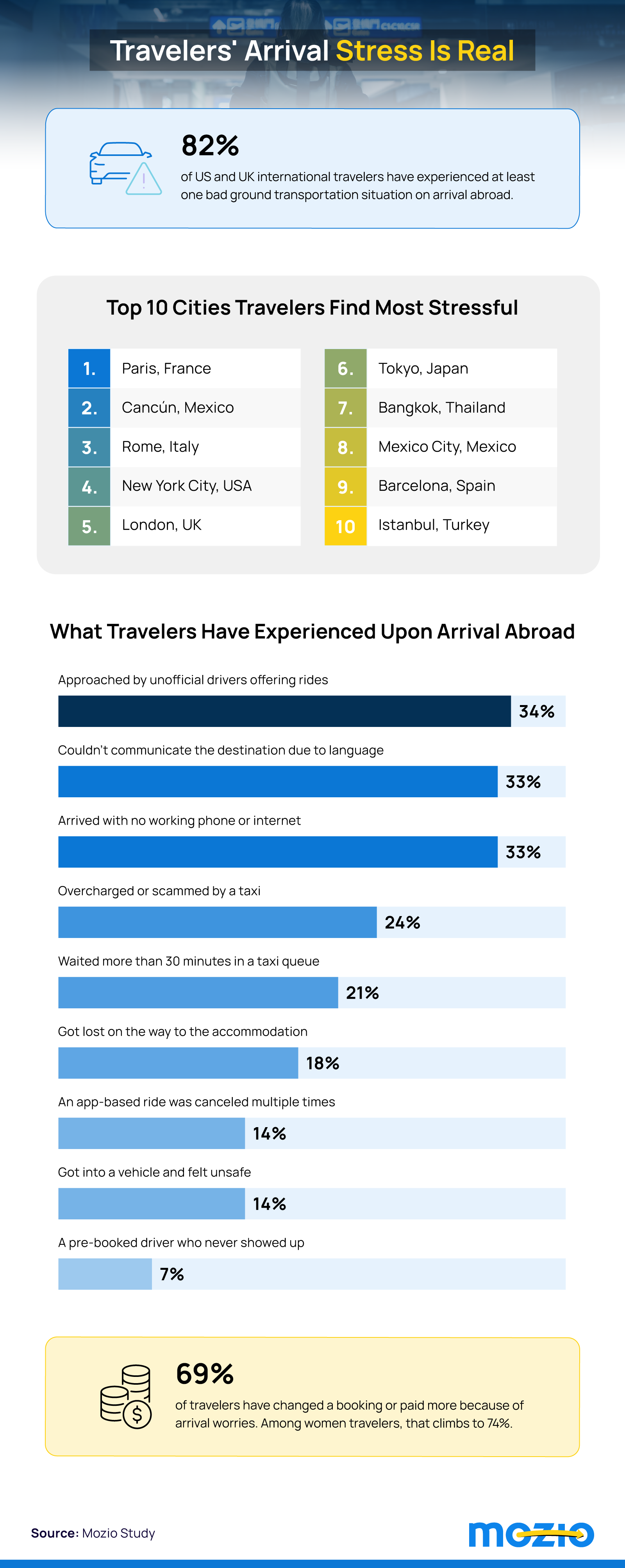
A majority of travelers (82%) have had at least one bad ground transport experience abroad, with little difference between US and UK respondents. About a third have been approached by unofficial drivers offering rides (34%), couldn't communicate their destination due to language barriers (33%), or landed with no working phone or internet (33%).
Others were overcharged or scammed by a taxi (24%) or waited more than 30 minutes in a taxi queue (21%). UK travelers reported taxi overcharging at a higher rate than Americans (28% vs. 23%).
Smaller groups got lost on the way (18%), had an app-based ride canceled repeatedly (14%), or got into a vehicle and felt unsafe (14%). Those who felt unsafe peaked at 16% among $50K–$100K earners but dropped to 8% among $250K–$500K earners.
Among cities they'd visited, travelers named Paris as the most anxiety-inducing (13%), ahead of Cancún (11%), Rome (9%), New York City (8%), and London (8%). Tokyo, Bangkok, Mexico City, Barcelona, and Istanbul round out the top 10. The top 3 most stressful cities ranked the same for US and UK travelers.
The cumulative effect shows up in behavior: 69% have changed a booking or paid more because of arrival worries.Arrival anxiety isn't hypothetical for most people. They've lived it, and the stories are easy to recognize.
Given the choice between saving money and removing uncertainty, most travelers now pick certainty, and they're rearranging whole trips to get it.Arrival anxiety isn't hypothetical for most people. They've lived it, and the stories are easy to recognize.

Many travelers are responding by arranging the ride before they go. Nearly half (49%) now pre-book their airport transportation, with 18% booking every time and 31% most of the time. Pre-booking has become a particular habit among the older travelers: 53% of both Gen X and baby boomers and 51% of millennials do it always or most of the time, compared to 41% of Gen Z.
Most people arriving at an unfamiliar airport said they're willing to pay extra for a pre-booked private transfer instead of a standard taxi (80%). Only 20% said they'd choose the cheapest option. Most increases stay modest, with 56% willing to go up to 25% more. But 24% of travelers would pay 26% above or more, or say cost simply isn't the deciding factor.
The anxiety also affects choices well beyond the ride to the hotel. Nearly a third of travelers (31%) have booked a daytime flight to avoid a night arrival, a tactic women favor more than men (37% vs. 25%). Travelers have also:
Some have gone further, avoiding a destination entirely (11%) or booking a costlier flight to a different airport (9%). Gen Z stands out for one move in particular: 17% have asked a friend or family member to fly with them because of arrival concerns, more than double the rate for any other generation.
As for what earns travelers' trust in a transfer service, no single feature wins. Transparent fixed pricing (38%) and strong reviews from travelers in their home country (38%) tied at the top, followed by vetted, licensed drivers (36%). The signal is that travelers want a layered guarantee that includes a fair price, proven reputation, and a driver they can trust.
Arrival anxiety is one of the more honest emotions in travel. Many people feel it and have a story to back it up. And now, it's affecting how they book trips and what they'll spend.
If you're traveling somewhere unfamiliar, research the route from the airport to your hotel before you go, sort out a working phone or data plan, and arrange your ground transportation in advance so the first hour in a new city isn't the part you dread. These simple steps can help you improve your safety and peace of mind.
Mozio surveyed 1,006 international travelers from the United States and the United Kingdom to understand what they experience between landing at a foreign airport and reaching their accommodation, and how those experiences shape their ground transportation decisions.
Respondents were 74% US (749), 26% UK (257); 49% women, 49% men, and 1% non-binary. By generation, 48% were millennials (ages 30–45), 25% were Gen Z (18–29), 21% were Gen X (46–61), and 6% were baby boomers (62+). By income, 36% earn $50,000–$99,999 (or £40,000–£74,999), 23% earn $100,000–$149,999 (or £75,000–£99,999), 19% earn under $50,000 (or £40,000), 13% earn $150,000–$249,999 (or £100,000–£174,999), and 5% earn $250,000–$499,999 (or £175,000–£349,999).
Mozio is a global ground transportation platform that connects travelers and travel businesses, including hotels, airlines, tour operators, and travel agents, with airport transfer providers across 190+ countries and 3,500+ airports. On Mozio.com, travelers can compare and book private transfers, taxis, and chauffeur services in advance, so the journey from the airport to the hotel is arranged before they land.
The findings in this report are free to share for noncommercial purposes. We only ask that you mention Mozio and link back to this page so readers can review the full study and methodology.